During a conversation with my newly employed, recently minted college graduate, she shared an office observation. “The 30-year olds seem impossibly mature and together. How will I ever get there?”
This was precisely the same thought my husband and I had the day she was born. I lay against the pillow in my hospital gown; my husband sat gingerly cuddling our newborn daughter in his arms.
Into the room ran my 3-year old niece, a cracker in each hand excited squealing, “I hold the baby!”
Our eyes darted to this capable 3-year old who could walk and talk and eat crackers. Then we gazed at our swaddled infant and thought, “how will our daughter ever get there?”
So when our younger daughter turned 21 and could walk, talk and eat crackers as well as drive a car, use a debit card and even mow the lawn, we said to one another, “well done on the parenting!” with the emphasis on done, our children were now capable, self-sufficient adults.
When I was in college I took a number of complex math courses. The classes always seemed to be late in the afternoon, and as the low sun angled in the windows, a room full of 20-year olds frantically attempted to follow the instructor as he scribbled out a proof on the blackboard. Invariably he would run out of room on the chalkboard or run out of time in class or both, and so would quickly scrawl, QED. To the lecturer this meant the rest is obvious, I have demonstrated the hard part.
And now, 30 years later, the roles were reversed. It was as if I were the lecturer, and the time in my classroom had drawn to a close as my youngest child turned 21. From there to 30? QED, or so it seemed to me.
I could see my daughter turning over in her head the concept of 21 to 30 being obvious. Like me and my fellow classmates gathering our notebooks in math class so long ago, QED only meant one thing to her, how in the hell do you get there from here?


Turning to the School Yard to Solve a Peruvian Driving Conundrum
The Problem:
Peru seemed to be dominated by roadways that were developed before vehicles. And, it turns out they were. From the old section of Cusco, to the rural countryside, we frequently observed two-way roads that were only barely wide enough for one-way traffic.
 We walked along a sidewalk wedged between the storefronts and the street. The sidewalk was so minimal that not only were two pedestrians unable to pass without one stepping into the road, even a single pedestrian needed to carry parcels in her street-side hand, or more commonly on her back, to keep them from rubbing against shop windows. Seemingly as an afterthought, squeezed between the facing sidewalks was a cobblestone street nearly too narrow for one small car to negotiate. Yet the streets were all considered two-way. Consequently, when two cars met traveling in opposite directions, one needed to reverse to the preceding intersection to get out of the way. But not always. We watched as two cars crept past one another, each with two tires on the sidewalk, side mirrors nearly scraping as they passed.
The Solution:
While some municipalities might solve this problem by widening roads or designating some streets as one-way, Cusco leadership seems to have thought out of the box for a resolution: driving classes during elementary school recess. Yup, as we wandered up the narrow streets, we spotted a large school yard with several dozen kids at play. A few were enjoying a game of soccer while the vast majority were eagerly pedaling Fred Flintstone-style cars around roadways painted on the playground asphalt. This wasn’t simply an oval track. This road system included traffic lights, stop signs, crossing guards, pedestrian crossings, left turn lanes and lots of pint-size cars all driven by 8-year olds. 
You Got This Mom!

“Vamos!”
While offered with a cheery inflection, “vamos!” none-the-less conveyed a command to resume planting one foot in front another as we climbed to the 15,200-foot pass. My footfalls were slow and consistent. With each step I repeated to myself one word of a four-word phrase: Step, “you”, step, “got”, step, “this”, step, “mom.” However, as I continued up the incline inching closer to our goal, my pace slowed dramatically. I adjusted my mantra to: right foot, “you… you,” left foot, “got.. got”, right foot, “this… this,” left foot, “mom… mom.”
I looked ahead hoping to spy horses coming down the trail. Turns out that the best course of action when meeting a horse train while trekking near Salkantay in Peru is to stop, move to the side of the trail and let the horses pass, which offered easily a minute’s rest. Unfortunately, no horses were in sight.

An alternative hope: perhaps our guide Dalmiro would spot a flower or snake or point out a butterfly to us. Any educational stop offered more than sufficient time to regain steady breathing and simultaneously gain insight into the flora and fauna of Peru. For instance, one morning Dalmiro actively poked a snake with his hiking poles as he informed us it was indeed poisonous.
“Why are you poking it then?” I questioned.
“To catch it so everyone can see it!” Dalmiro responded enthusiastically.
Fortunately, the snake escaped into the undergrowth neither poisoning someone in the group, nor having its head chopped off.
During our downhill walks, our group’s conversation would be filled with laughter and plenty of games of broken telephone.
Just yesterday as we returned to our lodge, I found myself defining prophylactic for our Peruvian guide, who offered an animated analysis of why sexual drive is much stronger among jungle inhabitants than up in the mountains. His analysis—it all comes down to the amount of skin showing.
However, as we slowly progressed uphill, no voices broke the still air. The only sound was heavy breathing and, wait? What was that? An avalanche?
I looked toward Salkantay Peak and pointed with my hiking pole. My husband stopped and looked in the direction I was pointing.
“What do you see?” he asked.
As his question wasn’t of the yes or no variety I was unable to answer, having absolutely no spare breath to form words.
He seemed to catch on and followed up with, “An avalanche?”
To this I was able to actively respond with a nod of my head.
By the time we had paused a minute looking for the telltale puff of snow on the peak, I had regained my ability to speak and even pulled out my water bottle for a few gulps.
Looking ahead, I could actually see our destination—we were nearly at the pass—and with a final bit of focus and a couple dozen repetitions of my mantra, I indeed did have this and soon was happily basking in the sunshine at the top of the pass.
Improving My Photography: Wait For the Moment
Tip #1: Wait For the Moment
I have heard this advice repeatedly yet it's been difficult for me to put into practice. One of my biggest obstacles, beyond my impatience, is that I don't make photography my priority. Rather. I take my camera on my walk, or take my camera on my vacation, or take my camera to record the moment; a moment I don't even wait for!
So out I headed with my iPhone and photography as my priority. The following illustrates my best example of the snapshot versus waiting.

Two kids sit looking at books.

The moment when his sister puts a book in a bin outside the door causing the small boy to glance up.
The first is a nice photo without a compelling story. In the second a story is waiting to be told.
9 places to factor into your post-blizzard walking route

Good news, I have conducted a very unscientific survey (while walking, of course) and can provide the inputs for an algorithm to identify the best-shoveled sidewalk route.
For starters there are sidewalks that should definitely be avoided as they are the least likely to be cleared after a storm. For instance:

- Cross-walk access. Yes, definitely the most unlikely of snow-blocked routes, yet time after time while the sidewalk was clear and the street was clear, crossing the street would lead the walker straight into a significant snow-encounter.
- Post-offices— clearly the postal service has enough to do to reduce costs without focusing on clearly sidewalks.

- Gas stations— pretty obvious one here as their only goal is to get cars in and out so the easiest place to pile up the snow is one the sidewalk. Honestly, why would anyone want to walk by a gas station?
- Strip malls— serious uncleared sidewalkoffenders with an economic incentive. All of the strip malls I passed had well cleared passage into their mall. Draw the walkers in and maybe they’ll stay to shop.

- Seriously, in the photo at left, the sidewalk goes to the right of the shrubbery along the street. The cleared walkway in the left part of the photo goes along the strip mall and soon turns left, away from the sidewalk.
While those are spots to definitely be avoided, I need Google to find sidewalks that run in front of the following establishments:
- Places of worship— possibly due to their charitable nature or possibly to help new followers find the path to follow, literally, their sidewalks are among the first cleared post-storm.

- Train platforms— actually train tracks were far and away the most tempting route for my walk other than the high likelihood of meeting a train traveling at far greater speeds and with far greater mass than I, but that’s a physics problem for XKCD. So, Google, no need to include any well-cleared railroad tracks for my route. However, the platforms along train tracks are definitely fair game— well-cleared and wide enough for walking side-by-side with a friend.
- Libraries offer another wide-path alternative— wide enough for a double stroller to easily make it past. Perhaps there’s a high correlation between book borrowers and winter stroller walkers.
- Pizza parlors were a surprising find in the clear-sidewalk category. The sidewalks around the local pizza house were not only well cleared to the door, they were down to pavement all the way around. Shoveling might be a good way to cool off after standing in front of a hot pizza oven.

- Finally, considerate home owners. Identifying who might actually take the time to shovel using only the data available from a Google map is a little tricky.
At first I thought I saw a correlation between homes with porches and shoveled walks, but alas that quickly faded farther from the town center. Perhaps home-owners with driveways would be more likely to shovel their walk as they were already out clearing a driveway. That too proved a dead-end, perhaps they were too tired from shoveling the driveway.
Then I saw it— homes with a front door painted in a contrasting color to the rest of the house are far more likely to have a clear sidewalk out front than other houses. I didn’t come up with a reasonably hypothesis on why this would be, but with Google street view, front door paint color can often be discerned. If the color contrasts with the siding, trim and shutters then voilà! Add that house to my walking route.
So Google, just maximize walking past homes with contrasting front doors, pizza parlors, libraries, train platforms and houses of worship, while minimizing strip malls, gas stations, post offices and major intersections that need to be crossed. How hard could that be?
Downy Woodpecker tummy-to-tummy with Red-bellied Woodpecker
While many people easily confuse the Downy and Hairy Woodpecker when not seen side-by-side, I doubt if there’s much confusion over the Downy (on the left) and Red-bellied (on the right, with no red belly). Regardless, their bird feeder stand-off allows an easy tummy-to-tummy, as it were, comparison.

Night Skys
Picnic, check. Beach blanket, check. Forecast for clear skies and northern lights, check, check! Having read about the fickleness of clear skies and northern lights even when they are predicted, we headed to the beach early to enjoy the rippled sand and sunset. Any northern light sighting would be considered a bonus.

What a show indeed. The deep oranges of the setting sun reflected off every surface and reminded me of one of the pleasures of summer camp— lake sunsets that never grow old.
Every evening campers and counselors drift to the water’s edge in ones or twos or threes to watch the sun’s departing show. While artificial lights creep across our cities and suburbs, camp life celebrates natural darkness where only the occasional flashlight interrupts the moonlight dancing across the lake. Looking up into a star-studded sky and seeing a satellite slowing arcing past or spotting a shooting star or recognizing a constellation by name are gifts campers receive each summer.

These were the memories that flitted through my mind as I sat on the beach gazing north over the dark ocean, waiting expectantly for the northern lights. Was there a green glow above the horizon? Possibly. Was it the aurora borealis? Possibly, or possibly my imagination.
We looked up at the Big Dipper and Cassiopeia, enjoying the darkness and quiet. We may or may not have seen an the northern lights, but like a summer night at camp, we thoroughly enjoyed the delights of the night sky.
Passover in the Digital Age
Many years ago I hosted my first Passover Seder and placed steaming hot dishes of food on the table as we sat down and opened the Haggadah. First question, “why on this night did mom put dinner on the table and not let us eat?” The food was far from hot when we finally answered all four questions and completed our retelling of the Passover story.
Although I will never be mistaken for a quintessential Jewish mom, I have learned a lot about hosting a Seder in the intervening years. Perhaps my most important learning has been “make it relevant.” To that end, we retell the Passover story as a group with one person starting the narrative and others chiming in with additional details or the occasional correction:
“Miriam hid in the bushes and then a Princess, -"
“Actually the Pharaoh’s daughter.”
“Right, the Pharaoh’s daughter, came down to the river and saw the baby in the rushes.”
2014 marked the year that we made technology relevant to the Seder. Our household observes strict no-technology-at-the-dining-table rules. However, this year we embraced technology to bring together family across borders and share in our Seder via Google+ Hangouts. We set up a laptop at one end of the table, right beside Elijah’s cup actually, and those of us physically at the table crowded to the other end so we could all be on camera simultaneously.
The slight audio time-lag made the story retelling somewhat disjointed, but the pleasure of all sharing the Seder together more than compensated.
My daughter is now mulling over designs to transport food digitally so we can all share in the same food. However, even though we didn’t all serve ourselves from the same dishes, we certainly all shared a meal together.
Photo Tips for Nonprofits to Share

Selfie of the pope? Not too interesting. Photo of the Pope taking a selfie? That’s a story!
Most non-profits are always looking for new photos for a newsletter, a website, a Facebook page, slideshows, or possibly even to send to a local paper. In general, photos are needed whenever someone says, “Do you have a photo for this?”
It's likely that many of your volunteers have a Smartphone or a camera on hand. So here are some tips to share with your volunteers and hopefully you'll receive higher quality photos in return.
Do you need me to take photos?
Yes! Non-profit photos, like most good photographs, need to tell a story. So take photos for us and help us share the story of our organization.
Do I need to get permission?
Generally permission is not needed for photos taken in public places, however, non-profits should have specific guidelines on whose likeness can be used in different media whether online or in print. Find those guidelines and share them with your volunteers.
What are the key considerations to getting a good photo that we can use?
Two elements that turn good photos into great photos are composition and lighting.
Compose your photo to tell the story. For non-profit photos, what is the story you are trying to tell? Do you want to show a student studying, a group raising a wall into place, a ranger giving a talk on a native species? Are these just smiling faces or are these smiling faces building a house?Is this person walking in the snow, or is this person walking in the snow on a college tour? Are these children laughing together or are they laughing as they use the new backpacks your group just donated?
However, don’t get so far away that the you lose the personality of the subjects. If you’re unsure of the best composition, take 2 photos—one close up and one farther away with the subject off center and the background identifying the story we are sharing. Take the time to move yourself, your subject or stuff to avoid extraneous items in the background.
Lighting is also critical, most especially for any photos that will be shared in print, such as in a physical newsletter. Take the time to position yourself and your camera so you'll have the best light for the subject. Generally the light should be on the face for people shots, but you don’t want your subject squinting into the sun. A shady location on a bright sunny day works well. Sunlight reflecting off of water or snow onto a face works well.
How can I get great indoor photos at a concert or sporting event?
Indoor action shots are hard. You are welcome to try to capture photos of the basketball game your group sponsored or the solo in the orchestra for which your group donated instruments, but often between the lack of bright lighting, the movement and the distance you aren’t going to get a photo we can use in a wide variety of settings unless you don’t need to be reading this FAQ.
However, take the photos and send them knowing we may not be able to use them.
So ALSO take a pre or post-game/performance still shot. Get a couple of the performers or teammates together with a prop such as an instrument, an actual stage prop or sports equipment. Have them be silly or at a minimum create a composition other than a line-up: two players each holding on to a basketball, violinist pretending to play: show the story.
Should I take action photos or staged photos?
Action and candid shots are great to get when possible. When you take a candid shot the subject is candid—the photographer can be prepared! Think about where you are standing, where the subject will be, what the lighting will be like, what’s in the background etc.
Make staged photos interesting, read the answer to the preceding question.
Will my iPhone take good enough photos to use in publications or on website?
Your iPhone will take great photos! Just make sure when you share the photos you share it at “Actual Size”.
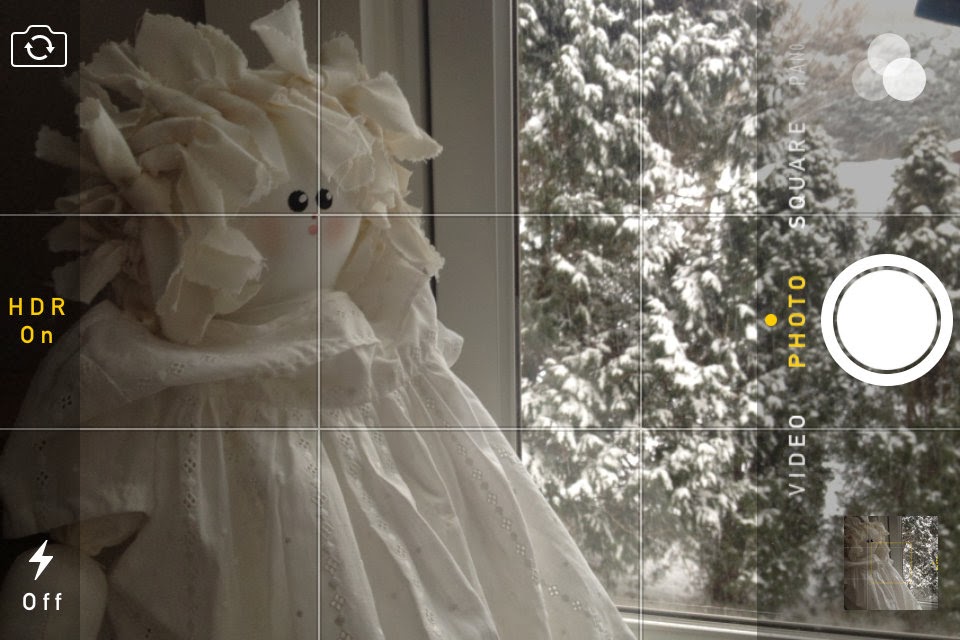 Your iPhone will take even better photos if you treat it like a camera. Turn on the grid and use the rule of thirds to compose an interesting photo putting the subject or an interesting area of focus somewhere other than smack in the center.
Set HDR On (on the top of your screen when you compose a photo) especially outdoors with a blue sky and a subject that may be shadowed.
Should I use a flash?
That depends… I’m not going to go into a whole photography class here, but if a subject is in a shadow use a flash. Better yet, take the photo so that the subject’s face has natural light and isn’t in the shadows.I just took a photo on my phone, what should I do with it?
Email it right away! When you email a photo it is very important to send the highest resolution photo possible. On an iPhone select “Actual Size” when emailing a photo. Don’t edit the photo; send what you have, we may want to crop or edit it for different uses.
I have photos on my camera, what should I do with them?
Upload your photos to your computer. Once on your computer you can email them to the photo master (person responsible for collecting photos). As an organization you should have someone responsible. If the organization has regular photographers then create a Dropbox or other shared folder to share lots of photos easily. Always email a photo at full resolution and as attachments (rather than inline). This may mean that you can only send one or a few photos at a time. Thumbnail photos will be of little use to showcase an organization's works.
Should I keep copies of all the photos I send to you?
You are welcome to keep your photos, but for our purposes, once the photo master has acknowledged that receiving your photo and it’s sufficiently high resolution you may do whatever you want with your copy. 
Neil Gaiman Writes for Homebound Winter Days

Author: Neil Gaiman
This is a book to own and to wrap your hands around and to feel how the letters are embossed on the book jacket after you have read the last page and need to hold on to the characters and their tale. This story transcends genre; it is the definition of story.
A story that brings out the child in all of us, or at least our memory of childhood.
Make no mistake, it's not lighthearted. It is the stuff of nightmares. As Maurice Sendak is quoted in the epigraph, "I remember my childhood vividly... I knew terrible things. But I knew I mustn't let adults know I knew. It would scare them." Neil Gaiman deftly transported me into my own childhood memories.
Some of the images (no spoilers) of childhood thoughts that rang so true...
The main character, a young boy, discovers a hole in his foot, "I do not know why I didn't ask an adult about it. I do not remember asking adults about anything, except as a last resort."
In the recounting of his tale that is the stuff of dreams and nightmares, the narrator says, "Why do I find the hardest thing for me to believe, looking back, is that a girl of 5 and a boy of 7 had a gas fire in their bedroom?"
Describing a black and white TV, "The vertical hold was unreliable, and the fuzzy black-and-white picture had a tendency to stream, in a slow ribbon: people's heads vanished off the bottom of the screen as their feet descended, in a stately fashion, from the top."
"Peas baffled me. I could not understand why grown-ups would take things that tasted so good when they were freshly-picked and raw, and put them in tin cans, and make them revolting."
"Adults should not weep, I knew. They did not have mothers who would comfort them."I took a journey with these characters and was left wanting more, but knowing that more could easily spoil the gift I had been given by an incredibly talented author.
As the snow builds up outside, curl up with a book and find your childhood.
In a word: Relationships

A word cloud formed from blogs on the value of overnight camp for campers and counselors conveys the essence of camp, and perhaps, of life : relationships.
Relationships with friends and campers and counselors, and yes with parents too.
Relationships with friends and campers and counselors, and yes with parents too.
Relationships with counselors who live in the moment and serve as valuable role models for children.
Relationships among campers who learn and grow to meet their potential, who arrive with trepidation and leave camp with memories and lives changed through the relationships they form each summer.
Relationships between children and parents who give the gift of summer camp knowing a child can gain more self-confidence and responsibility in a few weeks of summer fun than nearly anywhere else in life.
Look into an overnight summer camp experience for your child this year.
Look into an overnight summer camp experience for your child this year.
- 10 Reasons Why Businesses Should Hire Former Camp Counselors
- 5 Life Lessons Learned from Sleep-Away Camp
- What's Needed to Prepare Your Child for the Future? The Answer May Surprise You...
- Counselors Benefit from Camp Too!
For more blogs on camp visit: Summer Camp
Readers Discussion Guide for The Buddha in the Attic
 |
| The Buddha in the Attic |
By Julie Otsuka
I enjoy leading book groups. When I lead, I write up a discussion guide to use. Feel free to ask your own questions or discuss your own observations or reactions in the comments section.
I have moved this discussion guide to my new blog, Group Reads which is a collection of discussion guides. You can find a guide for this book at Group Reads: The Buddha in the Attic .
Stop by and see what other guides might interest you!
Hummingbird Impatience
 |
| A much more obliging photographer's model |
We had become enamored with hummingbirds since observing them enjoying sugar water from a friend’s hummingbird feeder. So enamored in fact, that the next day I ordered one myself and as soon as it arrived suctioned it to the window, filled it homemade nectar and sat down to await the arrival of flocks of hummingbirds.
I waited. Nothing. My husband and I waited together. Nothing.
“Maybe they will feed in the morning,” my husband offered hopefully.
That night he read late into the night, googling all he could find on the Internet about hummingbirds. The red of the feeder would attract them. They migrated from New England to points south anywhere from July to September. They needed to put on weight before starting their long flight and our feeder wouldn’t delay beginning their journey.
When I awoke, the first words I heard were, “maybe they have already migrated.”
All that day we watched out the window, hoping one straggler would still venture by our feeder. Just when our vigilance was beginning to wane we heard a loud buzzing overhead and watched in awe as a hummingbird first hovered above, then set down upon our feeder and dipped in his beak for a long drink of homemade nectar.
I was hooked and instantly sought to catch the hummingbird in a photograph. The first few shots through the window were easy to take, but sadly, the dirt encrusted on my windowpane was far more visible than the tiny bird hovering through the glass. I tried different times of day with the sun at different angles, but none captured the whimsy of the hummingbird.
Thus I began sitting outside, near the feeder, as even with a zoom lens the tiny stature of the bird required me to be quite close if I had any chance of it filling my camera frame. Not surprisingly the hummingbirds were keenly aware of my presence every time I so much as twitched.
I watched as the sunlight slowly started sliding towards my shady territory. Soon my foot was bathed in sun and the light and warmth continued to spread up my leg and my torso, until I wished I had chosen something other than a heavy sweatshirt as camouflage. I felt large beads of sweat form on my back, yet still I waited quietly for the return of my petite funny friend. Whenever I heard the loud drone above, I froze in place, hardly breathing. The hummingbird would alight on the feeder and just as I raised my camera, would zoom away as quickly as it had arrived.
I tried holding my camera in place, but between its heft and the heat of the sun I soon grew impatient and set it down in my lap. As if the hummingbird knew I was no longer at the ready, he darted in for a quick sip and darted away in the time it took me to lift my camera to eye level. After what felt like an hour sweating in the sun, but was likely no more than 15 minutes, I decided to create a photo memory. The next time the hummingbird came by, I didn’t move a muscle, just studied his feathers and beak and his red collar and created my own mental image of my tiny, feathered friend.
Ice Cream and A Show

We assured our guest that people-watching
at the lock was a fun summertime treat, right up there with the homemade ice
cream stand which we visited as part of our excursion. Invariably we would see
teenage girls sunbathing in their bikinis, eyes closed and apparently ear-lids
closed too as they remained motionless and oblivious to their parents’ requests
to “fend off from that boat in front!”
Or we would watch as new boat drivers tried to maneuver into the lock
without scratching along the lock door or any of the dozen boats packed in
around them. Once a coast guard
enforcement officer was on hand and was quick to ticket boaters with two
children who weren’t wearing life jackets even as they were dangling their
fingers over the edge of the boat between the fiberglass hull and cement wall
of the lock. “But they were
wearing them just 5 minutes ago”, the mother retorted. “We only took the life jackets off so
the kids could have their snack.” No
comment.
Today, however, was our most
eventful lock excursion to date.
We stepped out of our car just as over a dozen boats were about to enter
the lock. We watched with interest
as each attempted with varying degrees of success to follow the lockmaster’s directions
and move into place without knocking into any other boater or cement wall.
Surprisingly everyone on each
boat seemed to be helping to keep their boats from banging into one another
despite the best efforts of the drivers to play bumper boats. One boat had
a crew of three deaf men 'shouting' at one another and offering opposing
opinions on where to come to rest in the lock. The lockmaster motioned to the middle of the lock and the
deaf driver deftly directed his boat between two larger vessels.
As the lock filled we enjoyed watching
two boaters trading a cookie for a beer across boats— the swappers hadn't met
each other prior, just sharing what they had in good humor. When the lock
filled and the lock door swung open we anticipated an uneventful departure of boats
through the lock gate.
The boats slowly start pulling
out, most not quite slowly enough, and one was getting caught in the back
current outside the lock and slowed judiciously. Unfortunately the driver just behind the slowing craft, was
moving forward at a steady clip.
Her male companion sat with his legs dangling over the bow ready to fend
off of the decelerating boat. However,
the boat driver decided that the best way to avoid the boat in front would by
throwing her boat in reverse hard and fast without consideration for any one or
any boat that might be behind—and let it be noted that there were several boats
behind. Our shouts of “Stop!” went
unnoticed. As any student of
physics will know, a strong force applied in reverse while a man sits on the
edge of a wet boat deck will quickly unseat the startled man. The "splash"
of her companion hitting the water only just preceded the loud 'Crunch,
Scri--i-i-itch" of her engine digging into the bow of the motorboat behind
her.
The lockmaster remained serene
and calmly suggested they move on past the next bridge before stopping to
discuss the poor timing of their boats meeting.
Meanwhile while we had suggested the
driver stop reversing, we had not suggested she move forward, which she did
anyhow and nearly ran over her companion. Fortunately he was able to
quickly grab on to the bow of their boat and pull himself back on deck before
he was run over.
Yow za! What
excitement. I doubt we’ll be able
to match the excitement of a simultaneous crash and passenger ejection at the
lock any time soon.
Subscribe to:
Posts
(
Atom
)